Tuesday, September 17, 2013

Club Friday! My day with student clubs at American River College


Last week I attended two science-based student clubs on the American River College (ARC) campus, the Biotech Club and the Research Club.

I'm the Faculty Advisor for the ARC Biotech Club, and we started to get organized for the semester by selecting our club officers.


I also attended the ARC Research Club. Shih-Wen Young (Physics), the Faculty Advisor, helped students start the club last spring, and I serve as the Co-Advisor for the club.


At last week's meeting, the Research Club officers described the activities for the fall semester. 


Here's more information about the Brainwave Visualizer, which graphically represents your brain activity in real time.


So why should we support student clubs?

1. Clubs give students more hands-on experience with what we learn in the classroom.

2. Clubs give students opportunities to share and outreach to the community.


3. And we go on cool field trips!


In case you are interested:

The ARC Biotech Club meets 12 - 1 pm in Room 490 on Fridays arcbiotechclub@gmail.com

The ARC Research Club meets 3 - 4 pm in Room 307 on Fridays arcresearchclub@gmail.com

Thursday, September 12, 2013

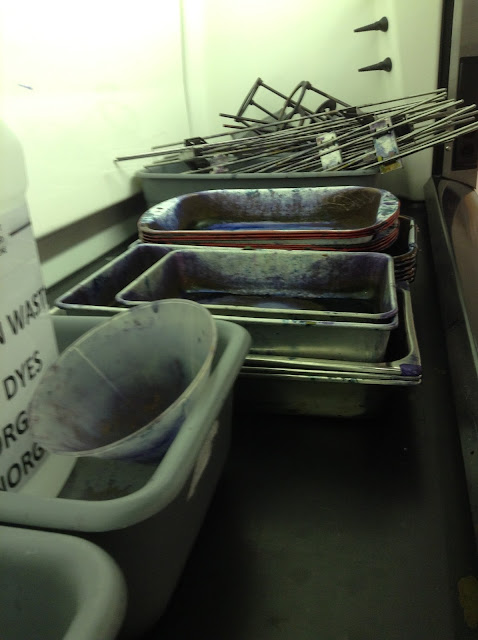
Microbiology students create Stackobacillus

The BIOL440 microbiology students are studying bacterial cellular morphology.


From Wikipedia


The microbiology students during lab invented a new arrangement of bacteria: 
Stackobacillus!


How the professor views Stackobacillus, as modeled by staining trays...


How students view Stackobacillus, as modeled by staining trays...


How the professor now views Stackobacillus...


From GIPHY

Wednesday, September 11, 2013

ARC Town Hall wrap-up: What ARC values in the next college President

Last Friday (September 6) American River College had a campus Town Hall meeting to get ideas about what to look for in the next college President. The Town Hall was full as the campus faculty and staffed offered their suggestions in an IBA (Interest-Based Approach) format.

Chris Iwata, Dean of Humanities & Fine Arts from Sacramento City College, facilitated the Town Hall, as his staff team collected our ideas on poster-sized white papers.

 Brandon Muranaka (Math) in discussion with Chris Iwata

In a previous post I proposed what I hope the Science Division can accomplish with the new President (and from the email responses I received, this view is shared by others in Science - thank you!). The Interest Based Approach addresses issues by emphasizing shared interests or values in the group rather than specific actions. So the IBA format turned out not to be the appropriate context to express Science-specific projects (new and/or improved laboratory space and updated equipment/supplies to support our laboratory space). However, the campus expressed several values that support our specific actions to better support our Science students.

Below are the Town Hall ideas about our campus values and interests in the next ARC President.


Tuesday, September 10, 2013

A note to my colleague, Prof. Marlene Martinez, about Field Guides

A quick post for my Biology colleague (and faculty office neighbor), Prof. Marlene Martinez: 


Although I appreciate your field guide for your Zoology students, this is puny compared to what I think is really needed: A Field Guide for Microbes!


Dr. Jonathan Eisen at UC Davis TBC 2013


Sunday, September 8, 2013

The beautiful dance of the Moon and Venus, captured on Twitter

Even in the screen age of Twitter, we can still go outdoors and gaze at wonder to the evening sky. The captivating pairing of the Moon and Venus in the early night sky, preserved in tweets.


Venus and Moon before occultation


Venus and Moon after occultation


Did you watch the Moon and Venus paired in the evening sky?

Thursday, September 5, 2013

ARC Town Hall Meeting - September 6: Science needs more attention

September 6 is the ARC campus Town Hall meeting to solicit suggestions on choosing the next college President. I plan to go. Why? Here's why:


The Science division has not received the resources it needs to support the type of learning we want to provide for our students. Several faculty have discussed and proposed projects that engage students in investigative, inquiry-based science projects, but our facilities have been insufficient to support this valuable component of learning science. With all the construction projects that have been done on this campus, we are still struggling among ourselves for laboratory space to support our courses. How will we be able to take the next step to foster the inquiry-based laboratory learning that we want? Yes, we do have a new Arts/Science building, but we did not get more laboratory space for our students.

Other campuses in California and the U.S. have STEM-enriched facilities that provide the space and resources to support hands-on, laboratory-based learning. The resources include updated equipment and technology to help students be more competitive when they transfer to four-year colleges or enter the workforce. So our campus can do better with science.


Since posting this, I've received some more points to add to our call for more attention to STEM education:

1. President Obama's administration has made STEM education a priority for the nation, as shown in the Administration's five-year strategic plan:
The health and longevity of our Nation’s, citizenry, economy and environmental resources depend in large part on the acceleration of scientific and technological innovations, such as those that improve health care, inspire new industries, protect the environment, and safeguard us from harm. Maintaining America’s historical preeminence in the STEM fields will require a concerted and inclusive effort to ensure that the STEM workforce is equipped with the skills and training needed to excel in these fields.
2. The Carnegie Corporation of New York is coordinating a collaborative national movement 100Kin10, which was created to meet the growing need for students with STEM knowledge and skills with 100,000 new excellent teachers by 2021

Wednesday, September 4, 2013

NIH Director Francis Collins sings "The Sequester Blues"

NIH Director Francis Collins visited the WAMU Kojo Nnamdi Show to give an NIH research update, and he played "The Sequester Blues." 


Here's another performance by the NIH Director:


About the NIH Director

The NIH Director's blog

The NIH Director on Twitter